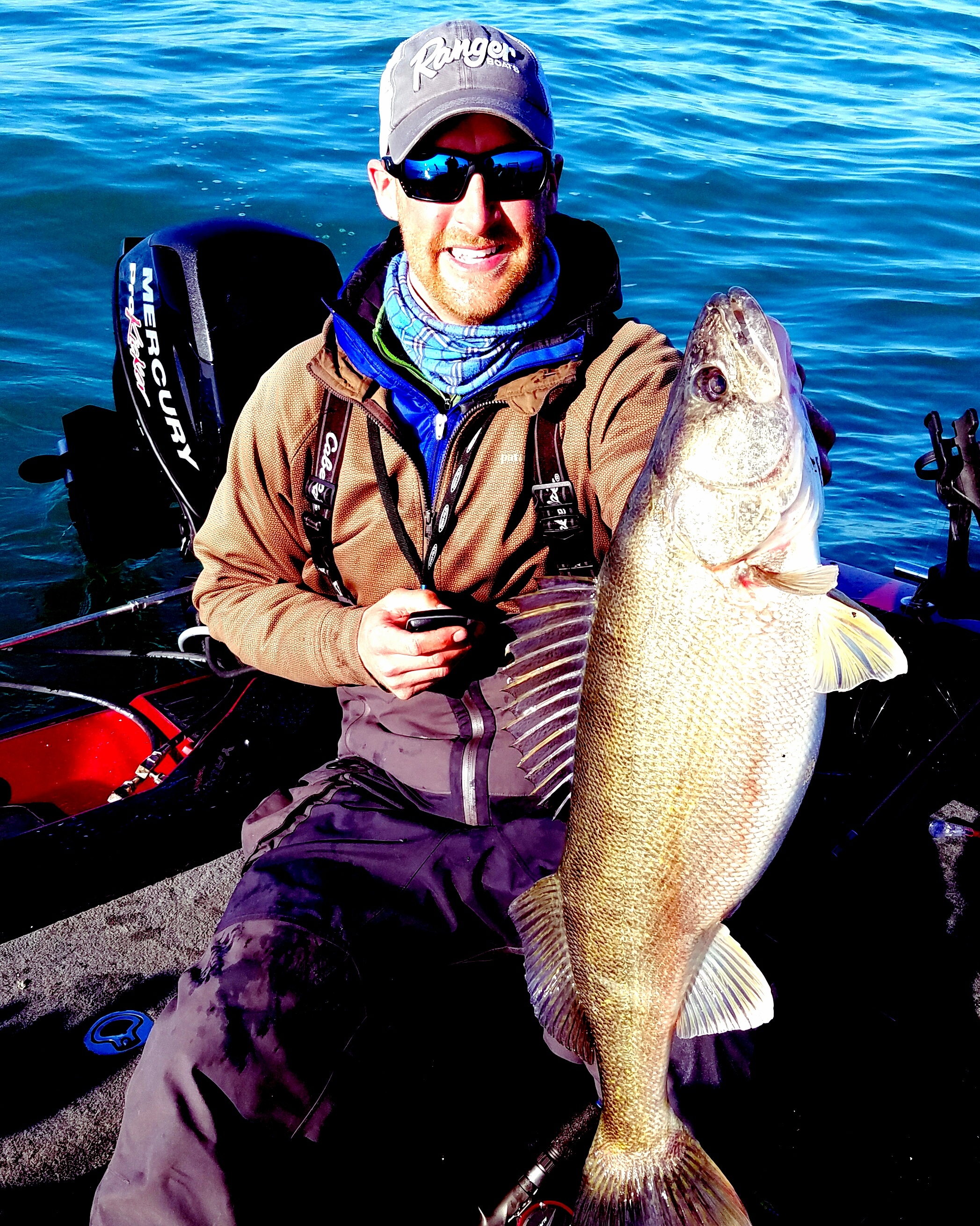
Winning the 2019 National Walleye Tour Championship

There are moments in a professional angler’s career that define everything that came before them.
The long practice days.
The early mornings.
The missed family events.
The tournaments where things didn’t go according to plan.
For me, the 2019 Cabela’s/Bass Pro Shops National Walleye Tour Championship on Devils Lake, North Dakota, was one of those moments.
Coming into the championship, the season had already been one of the best stretches of my career. A first-place finish at Marinette, followed by a runner-up finish at Sault Ste. Marie, had created momentum—but momentum only matters if you can finish the job when the biggest tournament of the year arrives.
The NWT Championship brings together the best anglers in the sport, and Devils Lake is a fishery that demands versatility. The lake is massive, constantly changing, and capable of producing winning patterns in multiple ways. Every angler in the field knew that one decision, one area, or one key bite could determine the championship.
The challenge was finding the right combination.
And then executing.
A Championship Built on Confidence
The 2019 season had already taught me something important: trust your strengths.
Throughout the year, casting had been a major part of my success. Instead of relying exclusively on trolling or traditional walleye tournament approaches, I continued to believe in an aggressive casting program that allowed me to cover water, find active fish, and trigger reaction bites.
That approach carried over to Devils Lake.
After the opening day of competition, the leaderboard was extremely tight. Mike Gofron held the early lead with a 28.22-pound limit, while several other anglers—including myself—remained within striking distance.
The championship format meant every fish mattered.
There was no room for an average day.
Battling Through Changing Conditions
The championship was originally scheduled around a multi-day format, but weather forced adjustments during the event. The field had to remain flexible and make the most of every opportunity on the water.
That is one of the realities of tournament fishing.
You can spend months preparing, but once competition begins, the only thing you control is your decision-making.
The anglers who succeed at this level are the ones who can adapt.
Heading into the final day, I was essentially tied with Dusty Minke, another outstanding walleye angler and a close friend. The championship was still wide open.
The final day would come down to execution.
The Final Day Push
Championship Sundays are different.
Every cast carries more weight.
Every fish feels bigger.
Every decision has consequences.
On the final day at Devils Lake, I focused on staying committed to the areas and techniques that had earned my position in the championship. Instead of chasing something new, I trusted the work that had already been done.
That confidence paid off.
I brought a 24.59-pound limit to the scales on the final day—the kind of championship-caliber bag needed when everything was on the line.
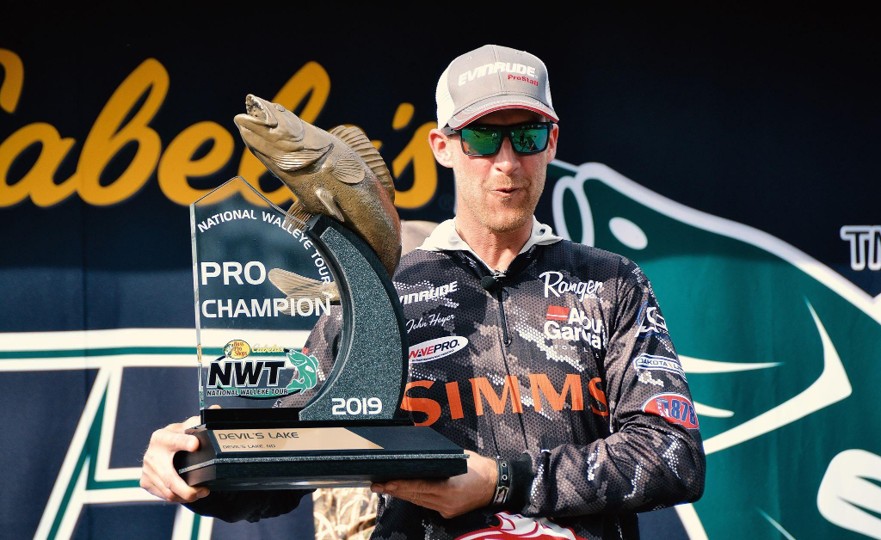
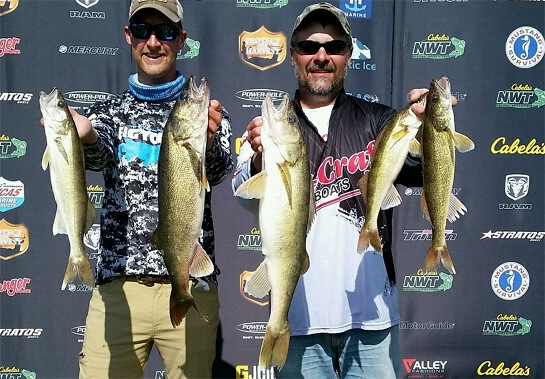
When the final weights were calculated, my three-day total of 67.73 pounds was enough to secure the National Walleye Tour Championship title.
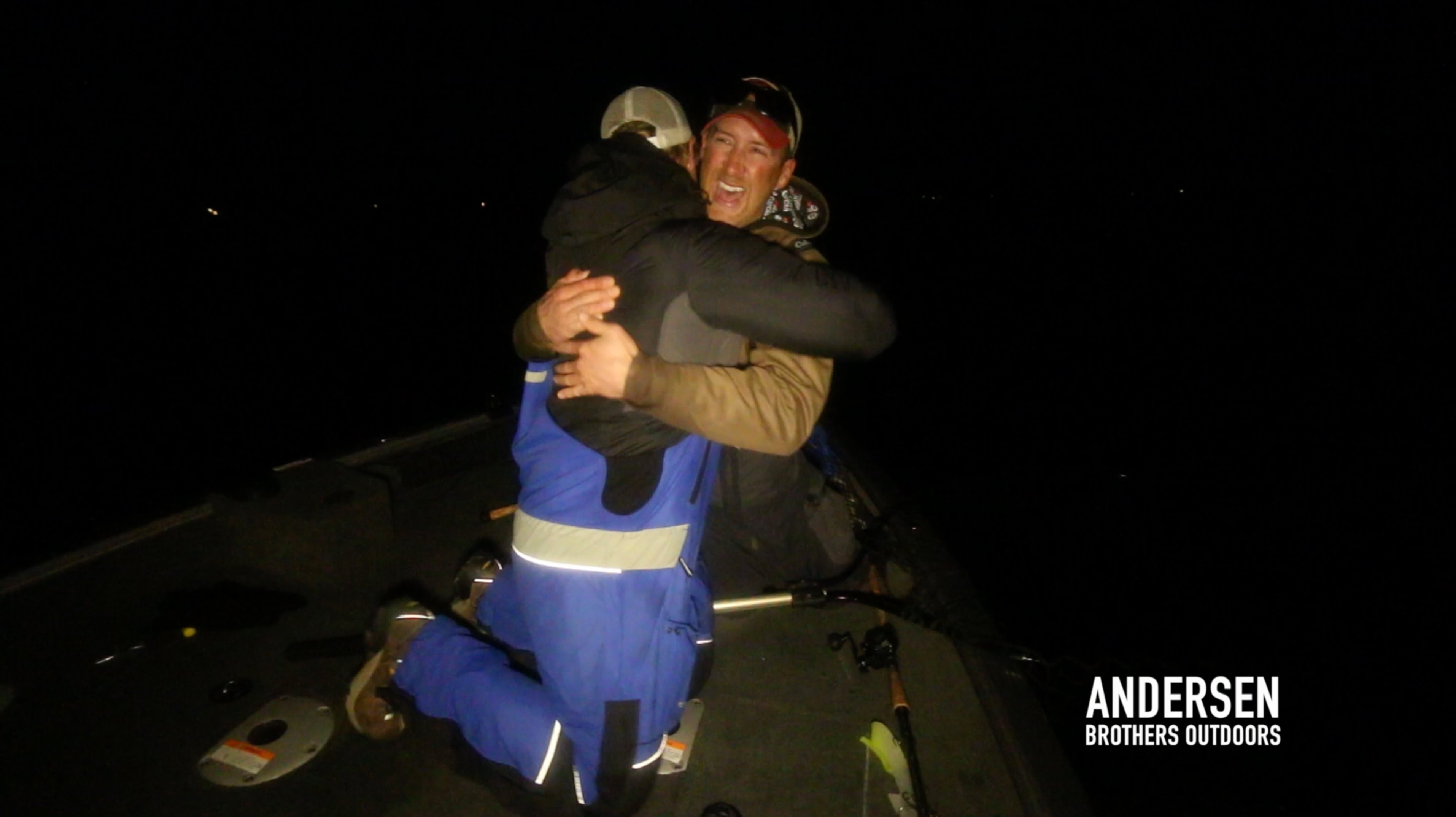
The feeling was hard to describe.
Winning any professional tournament is special.
Winning the championship—the biggest event of the season—is something completely different.
A Dream Four Years in the Making
What made this victory even more meaningful was the journey behind it.
Just four years earlier, I had made the decision to transition from guiding and competing as a co-angler into the professional ranks. That path required commitment, patience, and a willingness to keep learning.
In 2015, I had earned National Walleye Tour Co-Angler of the Year honors. The championship win in 2019 represented the next step in that journey—from learning the professional game to competing at the highest level and winning its biggest event.
Professional fishing is built on small improvements.
A better decision during practice.
A more efficient way to locate fish.
A presentation adjustment.
A stronger mental approach.
Those small details eventually add up.
The Season That Changed Everything
Looking back, the 2019 season was a turning point.
Three consecutive NWT events produced finishes of:
  • 1st place at Marinette
  • 2nd place at Sault Ste. Marie
  • 1st place at the Devils Lake Championship
That kind of consistency against the best anglers in the world doesn’t happen by accident.
It takes preparation.
It takes confidence.
And it takes believing in the process even when the results haven’t arrived yet.
The Devils Lake championship wasn’t just a tournament victory.
It was validation.
Validation that the decision to pursue professional fishing was the right one.
Validation that the preparation was paying off.
And validation that hard work over time creates opportunities.
Every angler dreams about winning a championship.
In 2019, that dream became reality.

2019 Sault Ste. Marie NWT 2nd Place Finish

One of the hardest things to do in professional fishing isn’t winning a tournament.
It’s proving the win wasn’t a fluke.
After capturing my first National Walleye Tour victory on Green Bay earlier in the season, I arrived in Sault Ste. Marie with confidence—but also with a renewed sense of pressure. The field wasn’t going to overlook me anymore, and the St. Marys River presented an entirely different challenge than Green Bay.
The National Walleye Tour had never visited Sault Ste. Marie before, making the event a true unknown for nearly every competitor. Between the St. Marys River, Lake Superior, Lake Huron, countless current seams, reefs, shoals, and expansive weed beds, there was an overwhelming amount of water to break down.
That’s both exciting and intimidating.
As tournament anglers, we spend practice searching for patterns rather than individual fish. When those patterns emerge, everything begins to make sense. During practice, I found exactly the kind of bite I was hoping for—an aggressive group of walleyes relating to healthy cabbage weeds.
Instead of relying on traditional live bait presentations, I committed to fishing a swimbait.
That decision proved to be the right one.
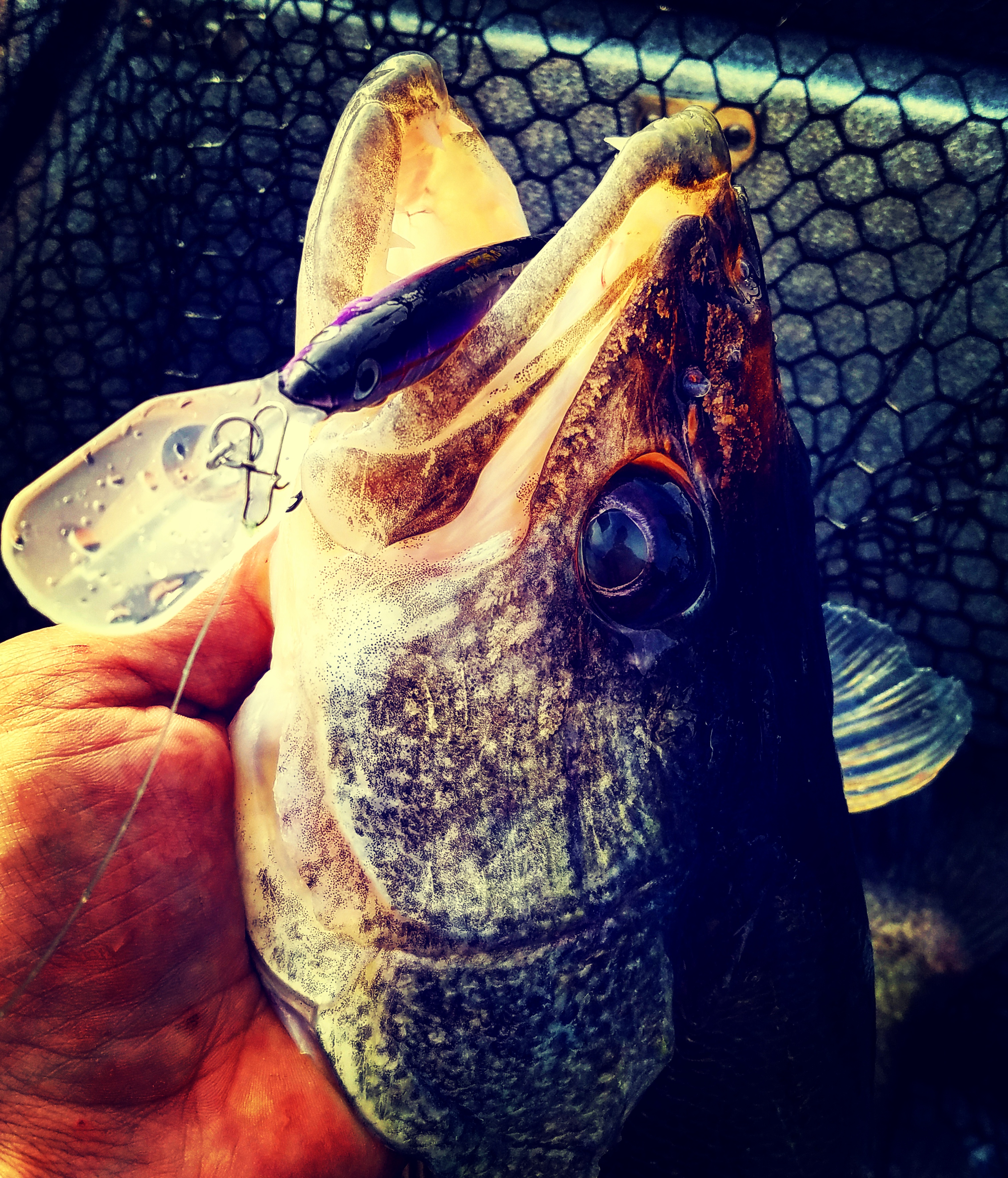
Throughout the tournament, I caught every one of my weigh fish on a Berkley PowerBait® The Champ Swimmer. The bait allowed me to efficiently cover water while triggering reaction strikes from active fish buried in the vegetation. My most productive colors were Black Crappie, Blueback Herring, and Yellow Perch—patterns that closely matched the forage those fish were feeding on.
There’s something special about watching a walleye absolutely crush a swimbait.
It’s an aggressive bite that keeps you engaged on every cast, and throughout the event I trusted that pattern completely.
When the scales closed after Day One, I was firmly in contention. But everyone on tour knows that Great Lakes fisheries can change overnight. Wind direction, current, water clarity, and fish movement all have the potential to reshuffle the leaderboard.
The challenge on Day Two wasn’t finding fish—it was finding enough quality fish to keep pace with one of the best Great Lakes anglers in the country.
Michigan’s David Kolb put together an outstanding tournament, capitalizing on an offshore pattern that ultimately earned him the victory. I was proud of the way our team executed throughout both days, bringing ten fish to the scales for a two-day total of 50.82 pounds.
When the final standings were announced, I finished in second place.
Of course, every competitor wants to win.
But tournament fishing is a long season, and consistency is what separates a good year from a great one.
Looking back, this event was incredibly important.
Following a victory at Green Bay with a runner-up finish against one of the strongest fields in professional walleye fishing proved that our preparation, decision-making, and equipment were working exactly as intended. Just as importantly, it provided valuable points in the race toward the National Walleye Tour Championship.
Those points would become even more meaningful later in the season.
Professional fishing is often portrayed as a series of trophies and highlight reels, but success is usually built on something much less glamorous: making sound decisions day after day, tournament after tournament.
Sault Ste. Marie reinforced that mindset.
The fishery demanded versatility. The conditions required confidence. And the results reminded me that momentum isn’t built from one spectacular week—it’s earned through consistent execution over an entire season.
As we packed up and headed toward the final events of the year, there was a growing belief that something special was happening.
The confidence from Green Bay hadn’t disappeared.
If anything, it had grown stronger.
The 2019 season still had one more chapter to write, and with two Top-2 finishes already on the résumé, the focus shifted toward the biggest prize in professional walleye fishing: the National Walleye Tour Championship.

2019 Marinette NWT Victory

Every tournament angler remembers their first big win.
Not because of the trophy. Not because of the paycheck. Not even because of the recognition.
You remember it because of everything that came before it.
For me, the 2019 National Walleye Tour stop at Marinette, Wisconsin, represented years of preparation, thousands of hours on the water, and a lifelong pursuit of becoming one of the best walleye anglers in the country.
When I launched my boat on Green Bay that week, I knew I had an opportunity. Green Bay has always been a place that rewards anglers willing to trust their instincts and commit to a pattern. During practice I found fish that fit my style of fishing, and the more time I spent on the water, the more confidence I gained.
Confidence is a funny thing in tournament fishing.
Sometimes it disappears after the first hour of competition. Other times it grows stronger with every cast.
At Marinette, it grew.
The fishery was loaded with quality walleyes, but locating groups of fish that could consistently produce over multiple tournament days was the challenge. My approach centered on covering water efficiently and staying committed to areas where I believed the biggest fish lived.
The first day validated everything I had discovered in practice.
Every fish that hit the net reinforced the decisions made during those long scouting days. The weather, conditions, and timing all aligned, but more importantly, the fish were doing exactly what I expected them to do.
That doesn’t happen very often in tournament fishing.
The best anglers in the country know that success usually comes from making adjustments on the fly. Fish move. Conditions change. Wind shifts. Bait relocates. Yet at Marinette, the pattern remained remarkably consistent.
Going into the final day, I knew the tournament was far from over. Green Bay is capable of producing giant bags in a hurry, and the field was stacked with talented competitors who could erase a lead quickly.
The key was staying patient.
Rather than chasing something new, I relied on the same process that put me in contention in the first place. Every cast had purpose. Every move was deliberate.
When the final weigh-in concluded, the reality finally sank in.
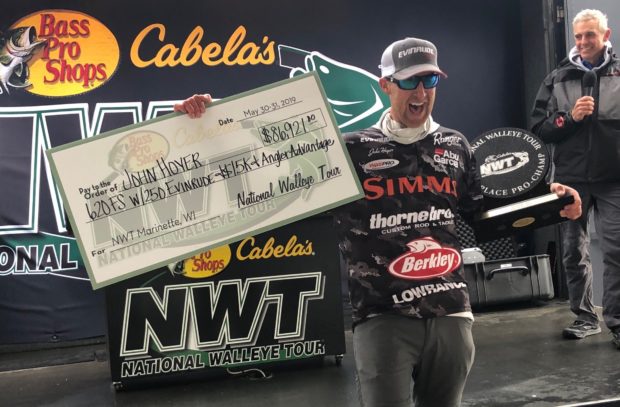
After years of working as a guide, competing as a co-angler, and making the transition into the professional ranks, I had earned my first National Walleye Tour victory.
The win carried even more significance because it represented a milestone that had motivated me for years. Becoming a successful professional angler isn’t about one great day on the water. It’s about consistency, perseverance, and continuing to learn from every experience.
Marinette proved that the approach was working.
The victory also provided momentum that would fuel the remainder of the season. Looking back now, it’s easy to see how important that event became. What started as a breakthrough tournament ultimately became the foundation for one of the most successful stretches of my professional career.
The 2019 season was far from over.
There were more tournaments to fish, more lessons to learn, and bigger goals still ahead.
But no matter what happened next, Marinette would always hold a special place in my career.
It was the tournament where a dream became reality.
It was the tournament where years of hard work finally paid off.
And it was the tournament that proved I belonged among the best walleye anglers in the sport.

2016 Cabela’s NWT – Lake Erie

Lake Erie is by far the crown jewel of Walleye fishing. It has an unimaginable number of walleyes in it, and a 27 incher is considered average.


I arrived on Wednesday the week before the tourney, and got right into the fish all day schedule  (my favorite).
The bite started off rather slow for our team, as we began to get a feel for the progression of the fish, finding out how far along they were with spawn, and how far East some of them had already started heading. Hot patterns were developed early on, with Berkley Flicker minnows, Bandits, and down deep Husky Jerks being on the menu. As the weather stabilized and went flat for  a couple days, I really started mixing in spinners, and in the clear water they definitely held their own. I experimented with a number of blades and beed combos, and arrived at the most gaudy options I had…a pink lemonade type #5 blade with pink chartreuse purple white beads.


 One day before the tourney, I blew the power head on the beautiful boat that my friend Brett Kenner had borrowed me. In case I didn’t have enough on my mind calculating where how and when I was going to fish my first tourney as a pro. I stayed calm and confident, only because history has always shown that God will work something out for me, as I went through the list of possible borrow boats, rental boats, etc. Etc. My heaven sent guy appeared.  Dan Smith, who travels with our good friend Ryan Buddies, offered me his beautiful Ranger 621 FS, and not only borrowed it to me, but also drove a 6hr. Round trip to get it for me the day before the tourney.


DAY 1.
I decided to make the 30 mile run to what I assumed was the biggest school of walleyes in Lake Erie. It was a 3 mile long school that was 1 mile wide….we went 6 for 10 in one long pass the day the power head blew up. So my thought process was, if I could catch 20 fish from that school, I would have upper an upper 30 lb. Bag to start the tourney, and could adjust for day 2 if need be…


When I got to the spot I had an unsettling feeling as I slowed down to 20 mph to start looking for fish….the HDS unit had massive interference from the hummingbird graph that was also turned on…I tried calmly to source a different transducer, and played with the settings a little bit,  but was unable to think about turning the hummingbird off with so much going through my head….eventually I slowed way down and finally marked some fish, enough to try a pass. The screen was lit up with fish, but the water was dingy and I wasn’t able to get them to bite, so I headed further west, and picked up my first fish, a 27 incher. On a slick alewive flicker minnow.
Pulled the pin and started heading back to the reefs, and then the south passage, and eventually further east, where I decided to make a pull in some ocean water where I knew it was hard to mark fish anyways on the graph.
One pass and we had a couple 29 inchers to show for it. And that is how day one ended.


 DAY 2.
Made the simple plan to start off where I ended, was going to get upper 30 lbs. Going then head to the reefs to try and upgrade a couple to pre spawn status. I started off with 2 Berkley Flicker Minnows on my outside boards 50 ft back, and 2 spinner rigs on my inside boards. 30 back with a 1 oz. weight.


As the magical day progressed , I was unable to fire any lure, they where eating every one equally , except we did notice at the end of the day that we were going to weigh 4 of the 5 thanks to the slick alewive  Flicker Minnow.
I didn’t really get my money’s worth day 2, because Keith and I had zero pressure on us at all. After our weak day one weights. That said, we finally high fived after we caught a close to 11-lber , which was a 5 lb upgrade!
We were having so much fun, that I was able to capture a lot of it on GoPro, and will share that as I upload it.


 Went to the weigh in, and got to hear one of my favorite voices announce our huge bag. Chip Leer was very excited because we just weighed the 2nd biggest bag of the tourney… 46.58 lbs of Lake Erie Gold. I assumed it wouldn’t be enough to get me in the money, and as more and more people weighed in I was bumped down to 40th place–two spots out of the money.

I’ll take it for my first tourney on the pro side. I learned a lot, and so did our team.
Can’t wait for the next one on Lake Winnebago, I’ll be ready to carry on this day 2 momentum.


Guiding Pastor Phil Hoyer to a Muskie

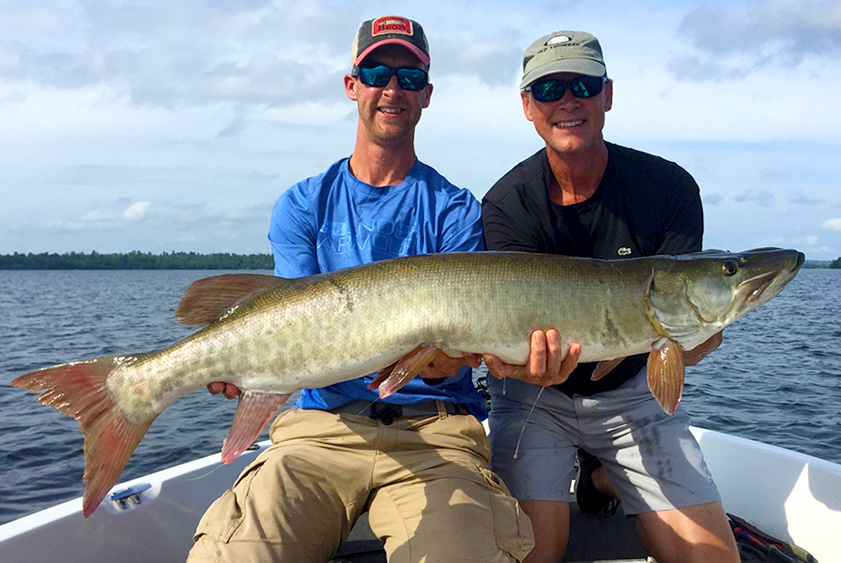
Muskies are cool. Lake Vermilion is cool. My dad catching a muskie on Lake Vermilion is cool. In the summer of 2015, I was able to fish with my dad, Phil on Lake Vermilion for two days. The fishing was tough, as always, and the weather was beautiful. One day after a nice lunch with my good friends, the wind started to blow, the clouds rolled in, and nice little mid-day window opened up for us. About 1/2 way back on the retrieve, a beautiful muskie grabbed Pastor Phil’s custom Showgirl and gave him a great battle before letting us take her picture. It was one of the high points of my summer and a moment I won’t soon forget.

Muskie Success Requires Diligence

By Jason Durham / For the Enterprise

First-time muskie anglers often call upon a fishing guide for instruction and counsel when pursuing the “Fish of 10,000 Casts.”
The client angler typically says, “I’ve never been muskie fishing before and would like to go on a muskie fishing trip.”

The reply from Leisure Outdoor Adventure’s fishing guide Jeff Anderson’s mouth are, “No, you don’t.”

You see, muskie fishing isn’t about watching a bobber twitch above a hook and worm. It’s a commitment. You’re essentially looking for a fish. A single fish. The biggest fish in the lake and the biggest fish most freshwater anglers can aspire to catch.

Though there are days when multiple fish are caught, the lulls can be long. Yet oral coaching is constant with Anderson.

Before and during a trip, Jeff Anderson mentally prepares the guest angler. “This is not easy,” he states. “A 50-incher in the first ten minutes isn’t common.”

His assessment of novice anglers is to-the-point. “Beginners typically don’t cast as far and you constantly want your bait in the water.

“Successful muskie hunters keep a positive mental mind-frame and have to love the ‘chase’ of fishing. The catching part comes second,” he says.

“Catching a muskie will eventually happen, but the pursuit should be almost equally enjoyable. Almost.

“Sometimes it feels like you’re just casting into a puddle,” states Anderson. “The best muskie fishermen always believe they’ll get a bite.”

The next important facet entails effectively placing the lure where fish live. Then keep focus, maintain a hook-set ready position and be meticulous with figure eights.

Fellow muskie guide John Hoyer adds that if a fish follows, read its attitude.

“Keep the bait moving and your first move is down with the rod tip, down below the fish. Then go slower into the high outside turn and then if the fish doesn’t bite, pull it away and down again.

“A muskie can eat literally anything that comes in front of its face, but the best figure-eighters are the best at cat and mouse. Get away, and then give the fish a chance to eat it,” says Hoyer.

Once the fish hits, Hoyer advises to keep the rod buried in the water; line tension is imperative. “The fish will go ballistic!”

The landing net should always be ready and the fish should be kept in the water, in the landing net as the fish is carefully unhooked. Then comes a quick measurement on a big bump board and an even faster photo. The camera should be ready before pulling the muskie out of the net.

Hoyer suggests wetting the bump board and avoiding fish to boat carpet contact. Be sure to support the fish horizontally versus a one-handed vertical hold. Then the fish goes back in the water.

“Don’t worry so much about pumping the fish back and forth to release, they simply need to rest and breathe. If the fish can remain upright on its own, it’s pretty much ready to swim away. But make sure it does.”

Brad Dirkman wins Cabela’s National Walleye Tour on Leech Lake; Laporte’s Jay Carroll is crowned co-angler champion

Three years ago Brad Dirkman of Underwood led the Leech Lake Walleye Tournament after the first day, but only weighed three small fish on the second day and fell to 10th place.

He was in the same position after day one Friday night of Cabela’s National Walleye Tour on Leech Lake.

This time Dirkman decided to play it safe on day two and it worked, as his total of 25.93 pounds won the pro-event and earned himself $63,127 in cash, bonuses and a new Ranger BMT boat and trailer.

Dirkman fished the first day on Walker Bay and did well with five walleyes weighing 18.35 pounds; and on the second day he weighed in five more for 8.48 pounds.

Under tournament rules, pros and co-anglers can keep two fish over 26 inches per day, and the other three must be between 15 and under 20 inches.

Tommy Skarlis, a former Walker resident, finished the pro-event in second place with a cumulative total of 25.93 pounds. Amazingly, he achieved that weight despite catching only seven keeper walleyes over the two days.

On day one, he managed only two fish, but they weighed 13.92 pounds. The second day he put a 12.01-pound limit in his live well — rising from fifth — to earn $23,628 with boat and motor bonuses.

The second-heaviest limit of the day belonged to longtime Nisswa guide Richie Boggs. After catching 8.53 pounds on day one, the veteran pro sacked a whopping 17.16-pound stringer and rose to third with a total weight of 25.69 pounds.

Rounding out the top five are Cabela’s pro Kevin McQuoid and Ohio pro Mark Brumbaugh. McQuoid started the day in third place with a solid slot program and slipped to fourth after catching a 9.87-pound limit. Like many others, McQuoid fished Walker Bay for his overs and had a milk run of spots for his slot fish. His cumulative total was 25.66 pounds, a weight that was achieved with just one over. If not for a .50-pound penalty for an expired fish, McQuoid would have finished second.

Mark Christianson of Walker was sitting in second place after day one with a 16.52-pound basket, but fell to 17th place after only bringing in two fish on day two for a total of 19.84 pounds, which did earn him $4,872 in cash.

Carroll crowned co-angler champion

Laporte angler Jay Carroll was crowned co-angler champion after catching 10 walleyes over two days weighing 32.12 pounds. This was Carroll’s first time ever cashing a check in a tournament and it was a big one at $6,926. His 19.94-pound day-two stringer was the heaviest of the tournament.

Carroll was almost speechless when he was announced the winner. “I’m speechless. I’m just happy to be here. This is just phenomenal.”

Finishing second in the co-angler was Cal Clausen of Veradale, Wash., with a two-day total of 30.11, which was good enough for $3,701 payday.

John Hoyer of Orono took third with 24.72 pounds and won $2,611.

The third qualifier of the 2015 Cabela’s National Walleye Tour season is slated for July 24-25 on Lake Michigan’s Green Bay in Green Bay, Wis.

Information provided by Brett Carlson, courtesy of Cabela’s National Walleye Tour.
Courts and Hoyer Win Angler of the Year Awards for Cabela’s National Walleye Tour

Welcome to WordPress. This is your first post. Edit or delete it, then start writing!NPAA Supporting Partner News
Published September 22, 2015

NEW SMYRNA BEACH, Fla. (September 22, 2015) – After the dust settled on the Cabela’s National Walleye Tour (NWT) championship event at Devils Lake, North Dakota, pro-angler Mark Courts and co-angler John Hoyer emerged as the Lucas Oil Angler of the Year Award (AOY) winners. Along with custom Lucas Oil AOY rings, both anglers earned paid entry fees for the 2016 NWT season.

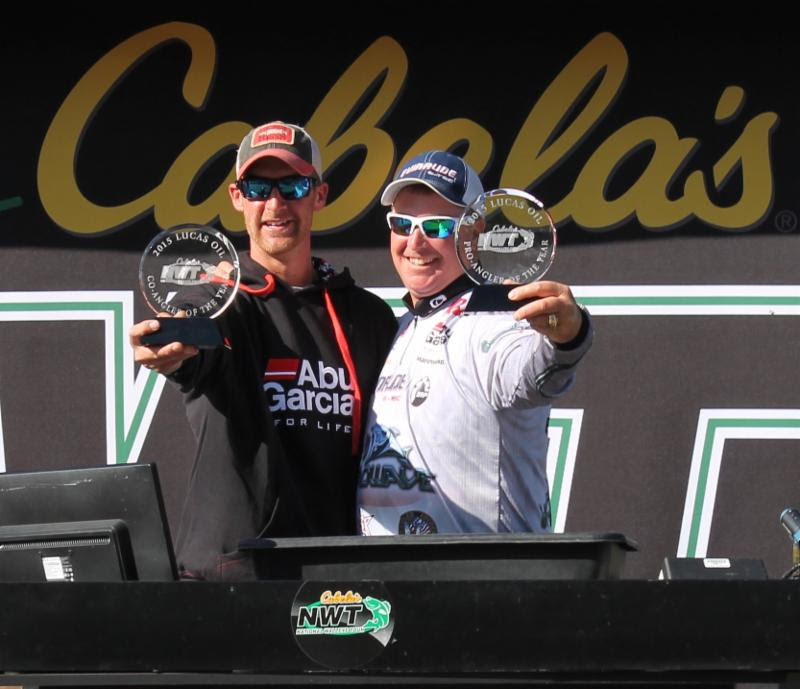
Pro-angler Mark Courts (right) and co-angler john Hoyer (left) pose with their Angler of the Year trophies at the Cabela’s National Walleye Tour championship event at Devils Lake, N.D., on Sept. 19. (For a high-res image, please contact Greg Duncan)

Courts has chased an AOY title for his 16 years of professional competition. After a number of tournament wins and close finishes in other AOY races, Courts can check this one off of his list.

“This was a huge relief,” said Courts. “It’s something I have strived for my whole career. That’s the one title I didn’t have. It’s something I am really proud of. Being that angler that stayed consistent enough throughout the year to win that title. I’m glad to have it up on the mantle.”
Courts made the decision to step up his game and become more aggressive with his decision making and tactics.
“I fished really aggressively all year,” said Courts. “I took some risks that worked out, which is always a part of being on top at the end. The one thing about tournament angling is there is always decision making involved. All of these decisions have to work out and this year it did.”
There were times during the season where Courts made mistakes but he didn’t let the setbacks put him in a losing mindset.
“I look at Green Bay where I lost a couple of crucial fish the second day,” said Courts. “That cost me some points, but I didn’t let it bother me. When we got to Devils Lake, I had a one point lead. That first day was where I almost mentally beat myself. I stopped and took a break to refocus. Then I settled in and started catching fish.”
Courts competed in all four NWT events and managed to place in the top 25 in each tournament. This consistency was key to topping the AOY leaderboard.
“It was one of those years where I was really consistent,” said Courts. “I fished really well and, for the most part, I fished really clean.”
John Hoyer finished first in the AOY race for the co-angler category with four straight top-10 finishes. After placing second at Lake City, Hoyer placed high again with third place at Leech Lake. The co-angler finished the regular season at Green Bay with another third-place podium call and placed fifth in the championship at Devils Lake.
“There’s obviously a lot of luck involved in the draws,” said Hoyer. “I tried to stay completely positive the whole time.”
Hoyer won over $10,000 fishing as a co-angler this season and plans to fish the pro category in 2016.
“This has kind of been the final push for me to finally go pro,” Hoyer said. “Fishing as a co-angler is the fastest crash course you can get as far as learning. Each pro does it just a little bit differently.”
Hoyer also credits his pro partners as an invaluable source of fishing knowledge with the pros always willing to impart a few bits of wisdom.
“They are very helpful,” said Hoyer. “We talk throughout the day and you can gain lots of knowledge from just talking. As much as you want to ask, they have answers for you.”
The Cabela’s National Walleye Tour will kick off the 2016 season in April and will include 3 qualifying events and a year-end championship. Dates and locations should be announced soon. For more details, anglers are encouraged to check out the website atwww.nationalwalleyetour.com.